Observable Links Between Agricultural Practices, Nutritional Status, and Economic Outcomes
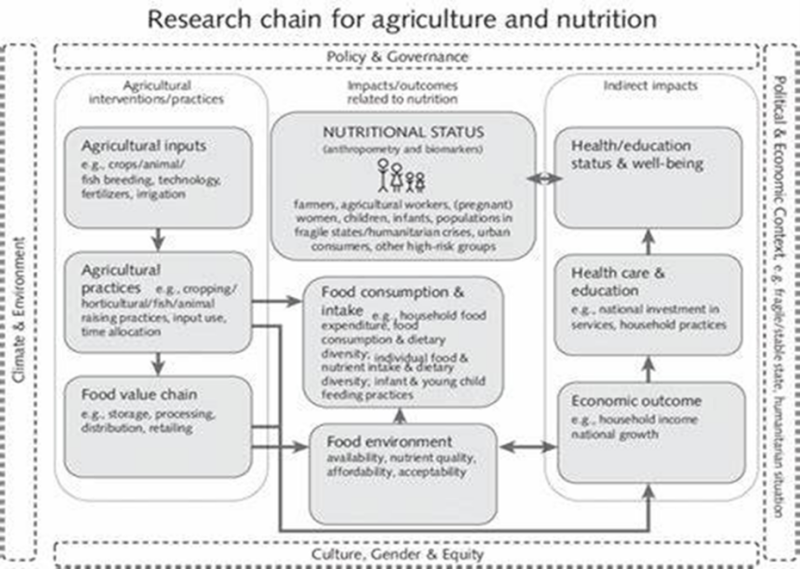
Theoretical framework for research on agriculture for improved nutrition. Source: Turner et al., 2013 (Above)
Climate smart agriculture (CSA) can be defined as agricultural practices that provide resilience to climate change, while also increasing productivity of agricultural settings. It's a broad term that includes many different practices, such as climate-smart macadamia agroforestry (CSMA). CSMA uses macadamia trees and intercropping of smaller ground crops (such as maize or beans) to provide food and climate security.
By using the theoretical framework from Turner et al., (2013) it can show us how agricultural inputs, such as crops or new technologies, influence the agricultural practices used. In this case the agricultural practice would be the agroforestry that makes up CSMA, where macadamia trees are intercropped with typical cash crops in Malawi, such as maize, groundnuts and soya (Neno Macadamia Trust, 2022). Therefore, greatly increasing crop diversification. Consequently, the uptake of agroforestry sees smallholder farmers enter the food value chain of storing and processing the macadamia nuts, before preparing the nuts for sale at markets. This is where co-operatives like HIMACUL enter the chain, where they enable smallholder farmers to gain access to markets, both on a local scale and on a larger (international) scale. HIMACUL and other such co-operatives play a key role in the distribution and commercialisation of macadamia nuts and have allowed smallholder farmers access to international markets, and direct links to ethical consumers, as seen with their current partnership with the UK based Nutcellars brand (Nutcellars, 2022).
It is therefore possible to observe how the uptake of new agricultural practices directly links into the increased levels of food consumption as well as noticeable economic benefits. This is a key sign that the benefits of CSA are prevalent with the increased productivity of agricultural settings as well as income levels increasing being one of the benefits defined by the FAO (2023). The economic benefits bought about by the adoption of new agricultural practices can then be seen to lead into increased healthcare investment and then subsequently greater wellbeing, before culminating in an increased nutritional status of communities.
Several studies have found links between these factors, such as Fatch et al., (2023) who stated that crop diversification (a secondary effect of CSMA implementation) has a direct positive impact on both income levels and nutritional wellbeing, Benfica and Kilic (2016) who theorised that policy change (in this case the uptake of CSMA) has the potential to raise nutritional levels across communities in Malawi, and Karp et al., (2005) who found that there is a direct correlation between income and nutritional levels. However, these studies failed to find links between all three factors: agricultural practices, nutrition, and economic benefits.
Consequentially, this framework provides a way to understand how larger scale uptake of CSMA could affect livelihoods of communities in Malawi, with figure 1 suggesting a change in agricultural policy could bring about widespread benefits. This allows us to address the gaps within the literature review and highlights how the uptake of CSMA can allow for increases in both income as well as nutritional wellbeing.
This is an extract from my dissertation 'Assessing the Impacts of Climate-Smart Macadamia Agroforestry on the Livelihoods of Communities in Malawi' at the University of East Anglia, 2023.
Max
Copyright protected, please do not save or copy the content of this website without permission. If you want to know more please contact me, contact details are available on my website.
References:
Turner, R., Hawkes, C., Jeff, W. and Ferguson, E. (2013). Agriculture for Improved Nutrition: The Current Research Landscape. Food and Nutrition Bulletin. [online] Available at: Agriculture for Improved Nutrition: The Current Research Landscape
Neno Macadamia Trust (2022). NMT - About Macadamia. [online] www.nenomacadamiatrust.org. Available at: https://www.nenomacadamiatrust.org/aboutMacadamia.html#nutrition
Nutcellars Ltd (2022). Home. [online] www.nutcellars.com. Available at: https://www.nutcellars.com/ ].
Food and Agricultural Organisation of the United Nations (2023). Climate-Smart Agriculture | Food and Agriculture Organization of the United Nations. [online] www.fao.org. Available at: https://www.fao.org/climate-smart-agriculture/en/
Fatch, P., Masangano, C., Jordan, I., Hilger, T., Kalimbira, A., Glas, M.G., Roehlig, A., Chiutsi-Phiri, G., Kamoto, J.F.M., Mambo, I. and Nuppenau, E.-A. (2023). Agricultural diversity linkage to income, wealth, diets and nutrition: Case of Lilongwe district in Malawi. Scientific African, [online] 19, p.e01569. doi:https://doi.org/10.1016/j.sciaf.2023.e01569.
Benfica, R. and Kilic, T. (2016). The effects of smallholder agricultural involvement on household food consumption and dietary diversity Evidence from Malawi. [online] Available at: The effects of smallholder agricultural involvement on household food consumption and dietary diversity Evidence from Malawi
Karp, R.J., Cheng, C. and Meyers, A.F. (2005). The appearance of discretionary income: Influence on the prevalence of under- and over-nutrition. International Journal for Equity in Health, [online] 4(1). doi:https://doi.org/10.1186/1475-9276-4-10.
Create Your Own Website With Webador